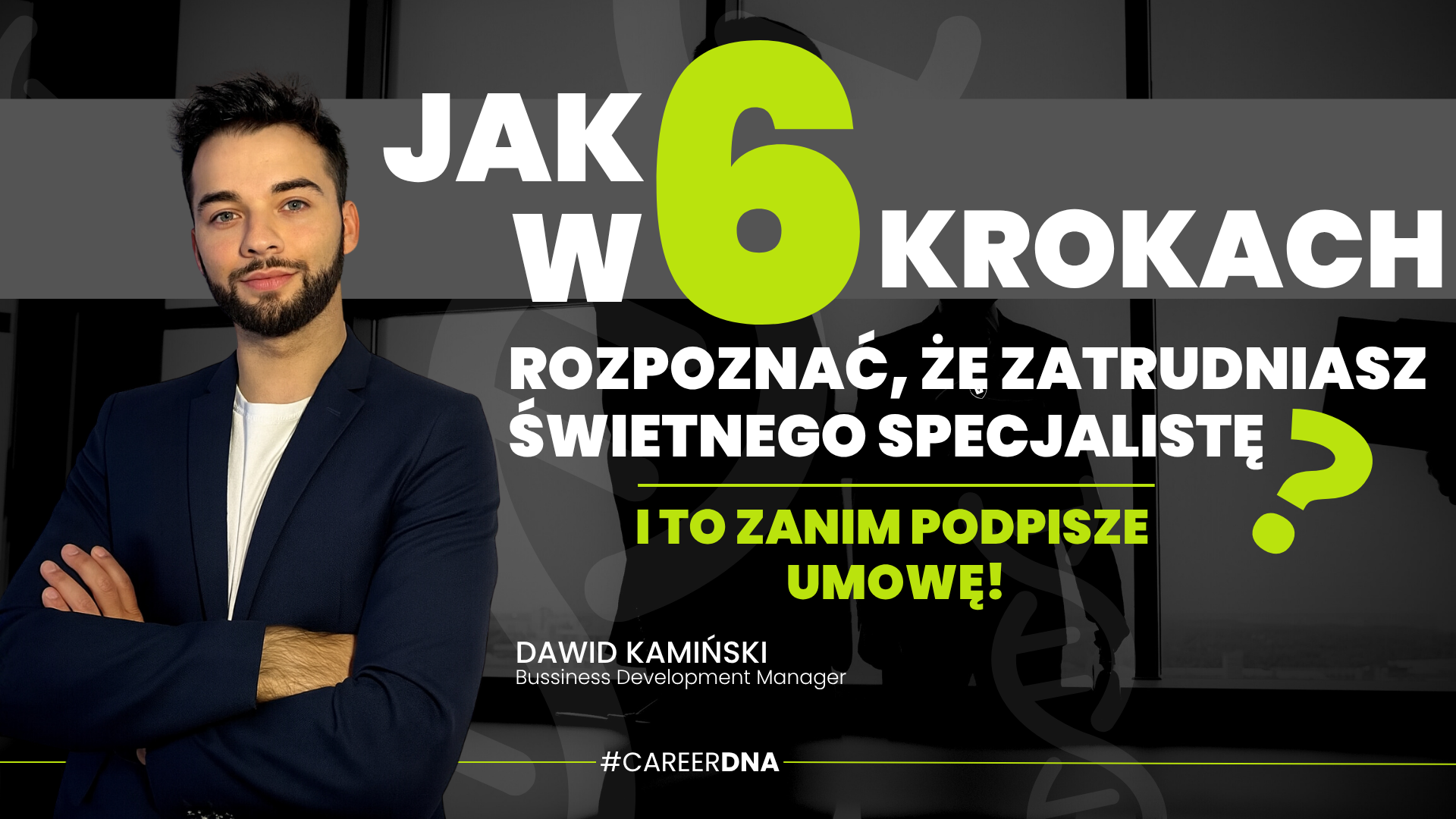
How to Recognize in 6 Steps That You Are Hiring an Excellent Specialist, Before They Sign the Contract
Hiring a new person rarely resembles buying a ready-made product off the shelf. It is more like an investment decision: costly, risky, and one whose effects only become visible over time. A CV may be polished like a board presentation, the conversation may flow smoothly, and yet after a few weeks it turns out that something does not add up: the pace of work, communication style, independence, or simply the lack of real impact on the team.
The problem is that truly good specialists very often do not make a lot of noise around themselves. They are not always the most impressive person in the meeting. They do not necessarily speak the language of corporate slogans. They are often not the best at “selling themselves,” because over the years they have learned that their strongest argument is not self-promotion, but delivering results.
For managers, HR Business Partners, and people responsible for recruitment, this is one of the most difficult moments in the process: how do you distinguish a candidate who performs brilliantly in an interview from one who will genuinely bring value to the organization? This question comes back especially when time is short, hiring pressure is growing, and several people along the way want to influence the decision, something clearly visible in the everyday reality of project managers, HR, and procurement. Some expect speed and specifics, others want control over the process, while others focus on formalities and risk.
Below you will find 6 signals that help recognize an excellent specialist before they sign the contract. They are not spectacular. But that is exactly why they work.
1. They do not speak in generalities. They speak in specifics
This is usually the first and one of the strongest signals.
A good candidate does not say that they “participated in a transformation,” “supported product development,” or “implemented new solutions.” These are sentences that sound good but mean little. An excellent specialist will rather explain:
- what problem the team started with,
- what exactly they were responsible for,
- what decisions they made,
- what worked,
- what did not work,
- and what the result was.
The difference is subtle, but fundamental. A candidate who truly has experience talks about work the way an architect talks about a building they designed: they know the layout, remember the constraints, and can explain why something stands exactly the way it does.
What should you pay attention to during the interview?
Instead of asking broadly: “Please tell me about your experience,” it is better to go one level deeper:
- “What problem were you solving?”
- “How did you know that the solution worked?”
- “What was the most difficult part?”
- “What would you do differently today?”
An excellent specialist will not be irritated by follow-up questions. On the contrary, they will usually be relieved that they can finally talk about the work itself, not decorative slogans.
2. They ask questions that show how they think
Good questions are like well-positioned lighting on a film set: suddenly you see more than you could a moment earlier.
A candidate who truly understands their role does not limit themselves to questions about salary ranges, vacation, or the work model. Of course, these matters are important. But if they are the only questions, it is hard to talk about deeper motivation.
A strong candidate asks differently. They are interested in:
- why the position is open,
- what is currently blocking the team the most,
- how decisions are made,
- who they will work with most closely,
- how the company will know that this person has settled into the role well after 3 or 6 months.
Such questions do not come from curiosity for curiosity’s sake. They are a signal that the candidate is building a map of the terrain in their head. They do not only want to “get the job.” They want to assess whether they will actually be able to deliver results.
This is especially important for managers who have little time and expect someone to take responsibility rather than require constant hand-holding. In practice, this is usually exactly what people responsible for a project are looking for: someone who will not increase chaos, but organize it.
3. They can admit a mistake, and they do not turn it into a performance
In recruitment, many people still fall into the same trap: they look for candidates without scratches. Without mistakes. Without missteps. Without difficult stories.
But professional maturity is not about the absence of mistakes. It is about being able to name them, understand them, and draw conclusions from them.
When you ask a candidate about a situation that went wrong, pay attention to whether they:
- take responsibility for something,
- can separate facts from emotions,
- do not automatically shift the blame onto others,
- can say what they learned.
This is a very good maturity test. A candidate who talks only about a string of successes may sound impressive, but often the story is too smooth to be true. A career without any cracks is like a display table in a furniture showroom: it looks great, but says little about everyday use.
The best specialists usually have projects behind them that did not go perfectly. The difference is that they do not sweep those experiences under the rug. They can turn them into better decisions.
4. They do not oversell themselves. They show how they operate
This is one of the most underestimated signals.
A weaker candidate often talks about themselves through labels: “I am proactive,” “I am a great leader,” “I have highly developed interpersonal skills.”
A stronger candidate does the opposite. They do not name traits, they show behaviors.
Instead of saying:
“I have ownership”
they will say:
“I saw that the topic had been stuck for three weeks, so I gathered the data myself, prepared two options, and took them to the decision-maker.”
Instead of:
“I work well with a team”
they will say:
“There was tension between the business and development in the project, so we established one status rhythm and a shared list of priorities.”
That is the difference between a declaration and proof.
In recruitment, it is worth remembering a simple rule: the fewer adjectives and the more verbs, the greater the chance that you are dealing with someone truly good.
An excellent specialist usually does not need a big stage. A well-told example is enough.
5. They look beyond their own position
This is the moment when you distinguish an executor from a partner.
You can be very good “within your own area” and still not understand why the work is being done at all. Or you can look more broadly: at the business, customers, team, dependencies, priorities, and constraints.
The best candidates ask questions that go beyond their list of responsibilities. They want to know:
- what the goal of the project is,
- what hurts the organization the most today,
- where the process gets stuck,
- what the team needs apart from simply “filling the vacancy.”
This is especially important in project and technology environments, where even excellent specialist competencies are not enough if someone does not understand the context. A person may be very strong in terms of tools, but if they do not see the bigger picture, they start to function like a perfectly sharpened knife without a handle: technically impressive, but difficult to use safely.
For HR and managers, this is a valuable clue, because organizations are increasingly looking not only for a “specialist for tasks,” but for someone who can enter the role with responsibility and good judgment. This also matters where the process involves many stakeholders and communication between them can be more difficult than the competence assessment itself.
6. They are likable, but not because they entertain everyone
This is the most delicate point, because it is easy to misinterpret.
“Likable” does not mean: extroverted, charming, or great at small talk. Not every excellent specialist has the energy of a party host. And they do not have to.
It is about something much more important: whether there is naturalness, consistency, and respect in contact with this person. Whether they can listen. Whether they answer questions directly. Whether they are not playing a role. Whether you do not feel that every answer has been rehearsed like a line for an audition.
In practice, it is good to work with people around whom you do not have to guess “what the author meant.” Even if someone is reserved, they can be a very good colleague. What matters is that they give a sense of predictability, honesty, and normal communication.
This is particularly important for teams where relationships and the way people cooperate directly affect the pace of work. Candidate experience and communication quality matter not only for the candidate, but also for the people running the process, who are often company ambassadors while also trying to maintain an efficient flow of information between managers and the market.
What should you watch out for? Three common traps in candidate assessment
1. Confusing confidence with competence
Some candidates speak fluently, quickly, and with great ease. This makes an impression, but it does not always mean value. Eloquence can be excellent packaging. Check what is inside.
2. Rejecting calmer candidates too early
A person who is less impressive in the first meeting may turn out to be the strongest player when it comes to delivery. Not every expert needs to shine. Many simply work well.
3. Overvaluing the “chemistry” from the interview
A good atmosphere is an advantage, but not proof of competence. Intuition is useful, but it should go hand in hand with facts, examples, and the ability to verify them.
How can you check this before making an offer?
To make the assessment more accurate, it is worth basing it on a few simple principles:
- Ask for specific examples, not declarations.
- Ask follow-up questions about decisions, not only responsibilities.
- Check the way the candidate thinks, not only their employment history.
- Pay attention to the candidate’s questions, they often say more than the answers.
- Verify references or cases if the role requires it.
- Compare candidates according to the same criteria, not a general impression.
This is especially important where the recruitment process is shared by several parties and chaos can easily appear: the manager wants to close the topic quickly, HR ensures quality and fit, while procurement looks after formalities and business risk. In such conditions, the best decisions are made when everyone looks at the candidate through a similar set of questions and indicators, not through their own intuitions.
Finally: trust your intuition, but make it work with data
Sometimes after a recruitment interview you are left with a simple impression: “this person is probably good.” And that is fine, intuition can be a valuable tool. The problem appears when it becomes the only tool.
An excellent specialist will not always be the most brilliant person in the meeting. They will not always have the most polished CV. They will also not always create a “wow” effect in the first five minutes. But they will usually leave behind something much more valuable: specifics, maturity, a way of thinking, and the sense that this person did not come only to talk about work, they really know how to do it.
And that is exactly what is worth being able to recognize before the signature on the contract closes the process. Because good recruitment is not about choosing the person who performs best. It is about choosing the person with whom, six months later, you will still be satisfied with your decision.
 px) (5).jpg)