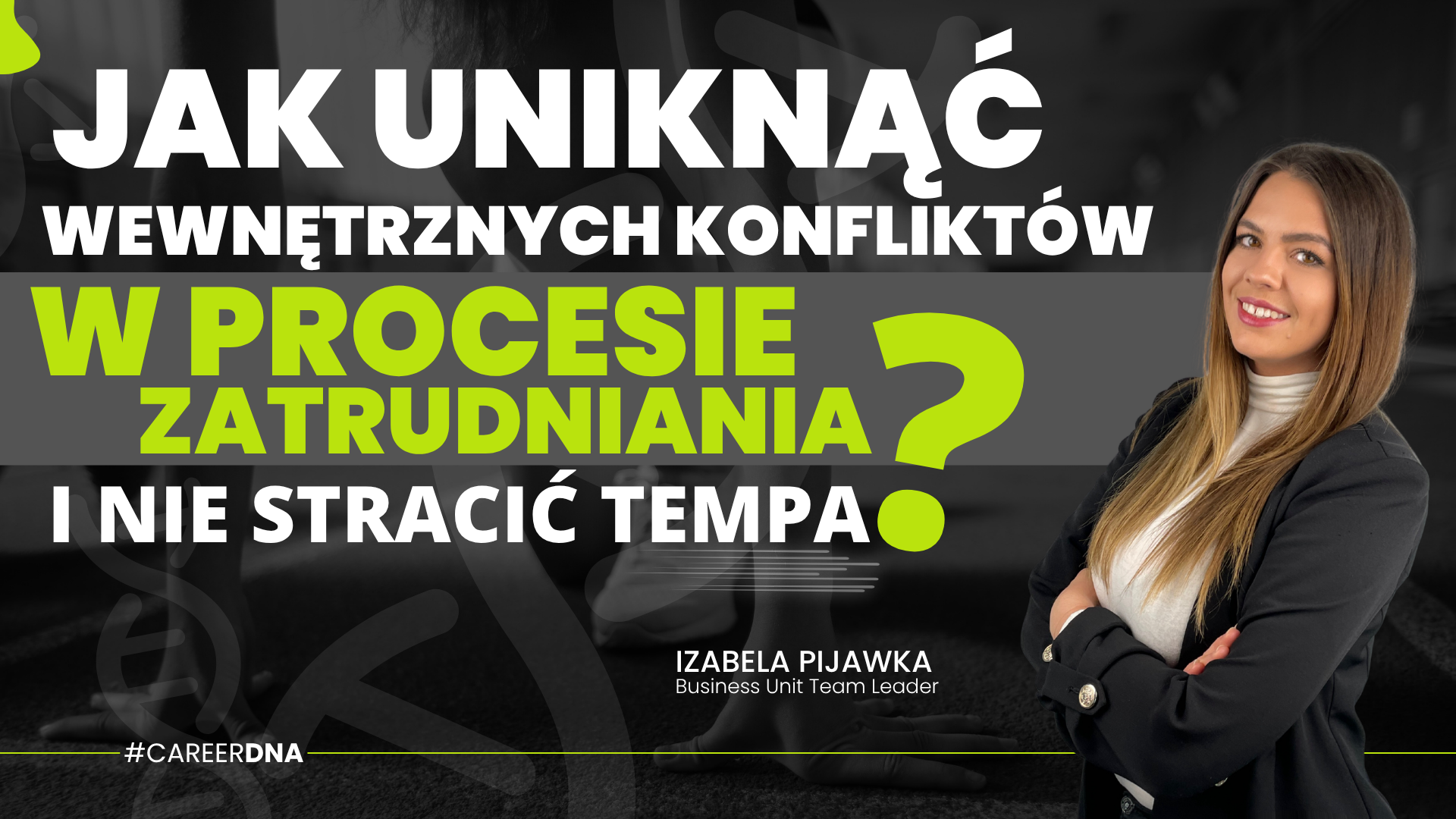
How to Avoid Internal Conflicts in the Hiring Process and Keep the Momentum?
The process of hiring IT specialists, especially under time pressure, can be a major organizational challenge. HR, procurement, and project managers often operate based on different priorities. For HR, candidate experience and cultural fit are key; for procurement, compliance with procedures and cost control matter most; and for the business, the priority is quickly delivering the right competencies to the project.
When communication between these areas fails, frustration grows, delays appear, and the entire recruitment process can become a source of unnecessary tension. That is why it is so important to develop a cooperation model that allows teams to act efficiently and without conflict. In exactly such situations, an experienced IT recruitment agency is increasingly playing an important role.
Why do internal conflicts arise in the hiring process?
Conflicts most often result from differing expectations across departments and a lack of clearly defined cooperation rules. Each party wants to achieve its own goal, but does not always have full knowledge of the limitations and needs of the other participants in the process. This leads to misunderstandings, longer recruitment times, and lower efficiency.
In practice, the biggest problems arise when there is no agreed communication path, no deadlines for feedback, and no clearly identified people responsible for making decisions. As a result, candidates wait for a response, project teams lose time, and the company risks losing the best specialists. The more critical the project, the higher the cost of such delays.
Cooperating with a recruitment agency, is it worth it?
Many HR and procurement specialists are concerned that a recruitment agency will take control of the process. In practice, however, a good agency works as a partner and supports the organization where the biggest challenges arise. Its role is not to replace internal departments, but to improve cooperation between them.
An experienced IT recruitment agency can genuinely strengthen the hiring process because it:
- facilitates communication between departments thanks to experience in working with different business stakeholders,
- ensures procedural compliance, taking into account procurement requirements and audit standards,
- shortens the time to hire by delivering initially verified candidates,
- minimizes the risk of unsuccessful hires by assessing both competencies and cultural fit.
Importantly, cooperating with an agency does not take control away from HR or procurement. Quite the opposite, it strengthens their position by providing tools, market knowledge, and operational support that help them make more accurate decisions.
How to speed up hiring a specialist for a project?
In IT projects, time has a direct impact on business results. Every week of delay in hiring a key specialist can mean real losses for the organization. That is why it is worth implementing several proven principles that help maintain recruitment momentum without losing quality.
1. Clear division of roles and responsibilities
At the very beginning of the process, it is necessary to define who approves the recruitment brief, who evaluates candidates, and who makes the final decision. Such a division reduces chaos and helps avoid situations where several people influence the process in parallel without clearly defined responsibilities. Transparency of ownership shortens response times and reduces the risk of conflicts.
2. Limiting the number of recruitment stages
In critical projects, an overly complex process works against the employer. In many cases, two interviews, a technical one and a final one, are fully sufficient to assess a candidate. The fewer unnecessary stages there are, the greater the chance of closing the process quickly.
3. Prioritizing feedback
It is worth setting a specific SLA for providing feedback after meetings with candidates, for example within 48 hours. This rule helps keep the process flowing and increases the chances of retaining the best specialists. Fast feedback also improves candidate experience, which strengthens the company’s image on the market.
4. Cooperating with an agency that has a database of IT experts
An agency with access to verified candidates can present profiles even within 24–72 hours. This is a huge advantage in situations where a project requires immediate competency support. As a result, the company does not start the process from scratch, but uses the partner’s ready resources and knowledge.
B2B cooperation with an agency, how does it work in practice?
Increasingly often, fast acquisition of a specialist takes place through IT expert outsourcing, most commonly in a B2B or contract model. This solution makes it possible to quickly fill competency gaps in a project without the need to run a long full-time employment process. At the same time, the organization maintains control over formalities and the course of cooperation.
Most often, such a model includes several simple stages:
- Defining the need, determining the scope of competencies, project duration, and budget.
- Presenting candidates, often within 36 hours of the briefing.
- Fast validation, short interviews verifying key competencies.
- Formalities and onboarding, the agency supports contract handling and compliance matters.
- Support during the project, ongoing contact and the possibility of making personnel changes if needed.
This model gives HR and procurement departments maximum formal control, while providing the project team with fast access to the competencies they need. This is particularly important in environments where flexibility and speed of action have a direct impact on project success.
Case study: what does effective cooperation with an agency look like?
In one project, a fintech company decided to entrust us with the role of talent acquisition partner. Together, we developed a cooperation model that met both business needs and formal requirements. As a result, the process became more predictable, faster, and better organized.
The results of the cooperation included:
- presenting the first candidates within 36 hours of the briefing,
- reducing the average time to hire from 8 to 3 weeks,
- establishing a clear information flow model and deadlines for feedback and the final decision,
- delivering candidates genuinely matched to business needs,
- ongoing calibration of candidate profiles based on client feedback.
The result was a shorter recruitment process, greater control over its course, and a better match between competencies and the role. This shows that well-designed cooperation with an agency can be real support, not an additional burden for the organization.
The most common concerns before cooperating with a recruitment agency
There are still many myths on the market about agency cooperation. In practice, most of them result from previous negative experiences or a lack of clear cooperation rules. That is why it is worth looking at these concerns from a more practical perspective.
Concern about losing control
The agency’s role is to be a partner and support for the client, not to take responsibility for final decisions. The client defines the requirements, expectations, and way the process is run, while the agency provides knowledge, recommendations, and operational support. The final decision always remains with the business.
Costs of agency services
Many companies view cooperation with an agency only through the lens of the service cost. Meanwhile, delays in project delivery, lack of key competencies, or an unsuccessful hire often generate much greater losses. In addition, flexible cooperation models, including individually agreed fee terms, make it possible to adapt the solution to the company’s current budget capacity.
Soft-skill fit of candidates
Effective recruitment does not end with assessing technical competencies. Already at the briefing stage, it is worth defining expectations regarding soft skills, work style, and team fit. This ensures that recommended candidates are verified not only from a technological perspective, but also in terms of personality and fit.
How to build an effective cooperation model between HR, procurement, and business?
Cooperation between HR, procurement, and the business does not have to be a bumpy road. The key to success is partnership, transparent communication, and clear rules of operation established at the very beginning of the process. These are precisely what reduce the risk of tension and help teams make decisions faster.
The best results come from a model in which each party knows its role, deadlines, and scope of responsibility. If the process is additionally supported by an experienced recruitment agency that understands the needs of all participants, recruitment becomes more efficient and more predictable. As a result, cooperation with an agency stops being a burden and starts genuinely improving the entire process.
Summary
Avoiding internal conflicts in the hiring process requires, above all, good organization, clear communication, and a shared goal among all departments involved. When this is combined with the support of the right recruitment partner, it becomes possible to reconcile speed of action with formal control and process quality. This is particularly important in IT projects, where time and the accuracy of decisions have a direct impact on the business.
If this topic is close to your experience or you see similar challenges in your organization, it is worth talking and exchanging experiences. Well-designed cooperation can significantly speed up the recruitment process and reduce the number of problems right from the start. Sometimes it is a few simple arrangements that make the biggest difference.
 px) (4).jpg)